
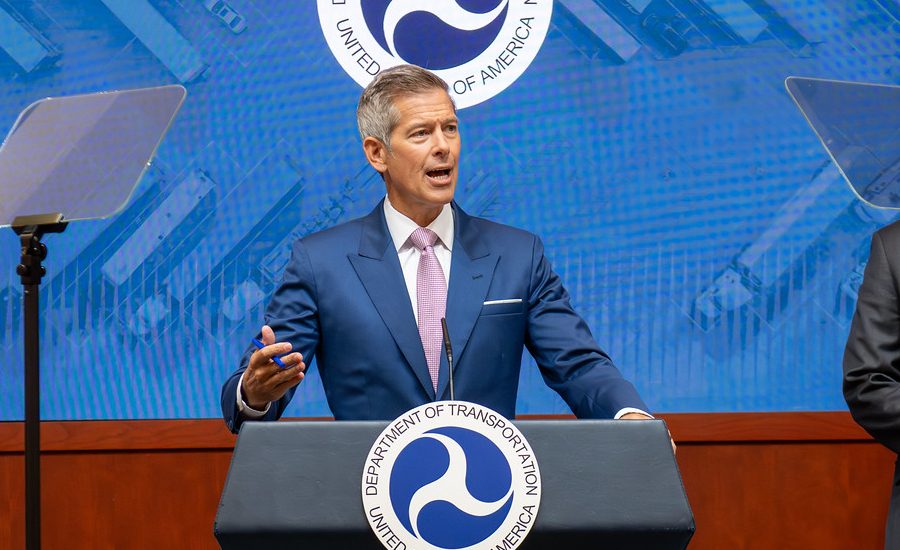

A brand new U.S. Dept. of Transportation rule upends the decades-old program designed to handle discrimination in authorities contracting in a transfer that company officers say will degree the taking part in area for small contractors. However the change has created uncertainty for a lot of trade companies over lack of readability in program necessities and the chance of decreased competitors going ahead.
The interim final rule, printed Oct. 3 within the Federal Register, removes sex- and race-based presumptions from the definition of a “socially and economically deprived particular person” underneath the deprived enterprise enterprise (DBE) program. As an alternative, DBE house owners should exhibit “individualized” social and financial drawback to take part in this system, irrespective of race or intercourse.
In an uncommon transfer, DOT printed the interim closing rule with out both first publishing a proposed rule and with out holding a public remark interval. As an alternative, the rule took impact instantly with its publication within the Federal Register, and the division mentioned it might take public comments for one month.
Taking public feedback upfront “could be impracticable, pointless, and opposite to the general public curiosity” as a result of the prior customary was unconstitutional, DOT wrote within the Federal Register.
Transportation Secretary Sean Duffy’s “place on the DBE program is evident—subsidizing infrastructure contracts with taxpayer {dollars} primarily based on discriminatory rules is unconstitutional, counter to civil rights legal guidelines, and a waste of taxpayer assets,” DOT mentioned in a press release.
President Ronald Reagan signed the DBE program into regulation in 1983 by to assist small companies owned by members of traditionally deprived teams compete for a share of labor on federally supported transportation tasks. To make sure companies are deprived, this system consists of caps on elements such because the proprietor’s internet price.
However eradicating the presumptive elements in drawback dangers discouraging participation, decreasing competitors and limiting variety within the pool of certified contractors, wrote Ladies’s Transportation Seminar, a building trade group that advocates for ladies within the sector, in a touch upon the rule.
“Many small, women-owned companies will discover it considerably tougher to exhibit ‘individualized social and financial drawback’ by burdensome documentation and narratives, regardless of the clear existence of systemic inequities that persist within the trade,” the group mentioned.
Wendell Stemley, president of the Nationwide Affiliation of Minority Contractors, says it’s important that small companies stay a part of procurement on public infrastructure tasks. The trade must welcome small entrepreneurs and innovators to stay globally aggressive, he provides, however guidelines like this danger making it harder for brand new companies to enter the trade.
“We are able to’t get to some extent the place we’re shrinking {the marketplace} because the world is opening up [its] market and making extra entrepreneurs … or we’re going to maintain falling farther and farther behind,” Stemley says.
Certification Evaluate
The rule requires that state applications that certify DBE companies, often known as Unified Certification Applications, use the brand new customary to reevaluate each DBE agency beforehand licensed, and to recertify or decertify companies accordingly.
“It’s a serious endeavor,” says Wealthy Juliano, basic counsel on the American Street and Transportation Builders Affiliation. The narratives to point out drawback signify a brand new process that Unified Certification Applications might want to clarify to contractors and supply specificity by way of what they’re on the lookout for, though state DOT officers have indicated they’re additionally in search of clarification on that.
One other problem would be the variety of companies in query—within the rule, DOT estimates 41,000 DBE contractors that might want to have their certification reviewed.
The division directed Unified Certification Applications to finish evaluations “as shortly as practicable” and mentioned it might work with them to reduce the sensible affect of the rule change—noting that certifying companies “might expertise elevated numbers of consumption inquiries and clarification requests.”
Contractors want readability from their respective state transportation companies on how the rule shall be approached, and the state DOTs want readability from the federal DOT, Juliano says, particularly given what number of companies work in a number of states.
“You don’t need a state of affairs the place you’re in a single state and also you go throughout the border and that is being dealt with otherwise, or expectations are completely different, or certification parameters are lots completely different,” he says. “You do want some consistency there.”
Stemley expects most present DBE companies will be capable of qualify underneath the brand new requirements. Impacts of slavery, in addition to post-slavery legal guidelines and practices akin to redlining that restricted African-People’ property possession, have restricted wealth throughout generations, he says. Different teams have additionally confronted adversity, akin to Native People whose historic lands had been taken by the U.S. and Japanese-People whose property was seized throughout World Struggle II. Their descendants are lacking out on generational wealth “that others are thriving from,” Stemley provides.
“I don’t suppose individuals can have a tough time recertifying into deprived standing and not using a presumption,” he says. “However then, what does it truly imply if the alternatives are fewer, and the alternatives are diluted?”
Within the meantime, recipients of federal transportation funding might not set any DBE contracting objectives, DOT wrote within the rule, successfully suspending all state DBE applications briefly.
“This provision ensures that present DBEs don’t proceed to obtain any advantages because of their certification underneath the outdated requirements,” the federal company wrote.
Following launch of the rule, state DOTs have begun notifying contractors that they’re suspending DBE objectives and monitoring. A number of mentioned they’re in search of steering from federal DOT on steps to take and whether or not the rule applies to tasks begun previous to the rule taking impact.
Quick Impact
DOT pointed to govt orders from President Donald Trump and a memo from Legal professional Normal Pam Bondi as directives requiring the brand new rule. The division has additionally sought to have a judge declare its DBE program unconstitutional as a part of a proposed settlement in a federal lawsuit in Kentucky introduced by Jeffersonville, Ind.-based Mid-America Milling Co. LLC and Memphis, Ind.-based Bagshaw Trucking Inc.
The choose in that case has signaled he might discover the DBE program to be unconstitutional however has not but decided. It’s potential the choose may ask events to revise the proposed consent order, or rule in an sudden approach.
“If he did something in need of approving the order because it’s proposed to him, that would additional complicate the state of affairs,” Juliano says.
Feedback to date have had a combined reception to the rule, however a typical theme amongst many was requests for clarification. One New Jersey-based contractor, which requested that DOT institute a transition interval to cut back hardships on firms and their staff engaged on impacted tasks, mentioned some companies have already canceled contracts and issued cease work orders because of the rule.
“The interim closing rule was issued with out thought and consideration to how federally funded tasks and firms/staff engaged on these tasks are affected,” the contractor wrote in a touch upon the rule.
Others requested DOT to go additional with the rule. One California highway security contractor wrote in a remark that the company ought to remove social drawback as a consideration solely.
Funding Freezes
The rule has additionally include the specter of federal mission funding being withheld or canceled. Two days earlier than the rule appeared within the Federal Register, DOT introduced that it was freezing $18 billion in funding for the Second Avenue Subway Part 2 and Hudson Tunnel Challenge within the New York Metropolis space to assessment DBE practices in mild of the rule.
On the day it printed the rule, DOT additionally introduced a freeze of $2.1 billion for the Crimson Line Extension and Crimson and Purple Line Modernization in Chicago for the same assessment.
“The federal authorities desires to right away ‘assessment’ our compliance with guidelines they instructed us about moments in the past,” John McCarthy, NY Metropolitan Transportation Authority chief of coverage and exterior relations, mentioned in a press release on the day of the federal DOT announcement.
Workers chargeable for conducting these evaluations have been furloughed, in accordance with DOT. It was not clear how lengthy the evaluations may take.
Trending Merchandise

KAFAHOM Power Tool Organizer Wall Mount, 4-Tier Drill Holder for Cordless Tools, 2-Pack Set, Garage Storage Rack with Side Hooks for Hammers & Pliers, Tool Organizer for Workshop/Utility Room




XMJY 5 Pack Funny Hardhat Stickers – Can We Fix It? No, It’s Fucked, Cute Cartoon Hard Hat Stickers for Builder, Waterproof Vinyl Stickers for Tool Box, Helmet (3 inch)

Cisily Brown Sponge Holder for Kitchen Sink, Sink Caddy Organizer with High Brush Holder, Kitchen Countertop Organizers and Storage Essentials, Rustproof 304 Stainless Steel, Soap Dispenser Organize

Mohawk Fil-Stik Wax Putty Stick, White M230-0202, 1 Count


