
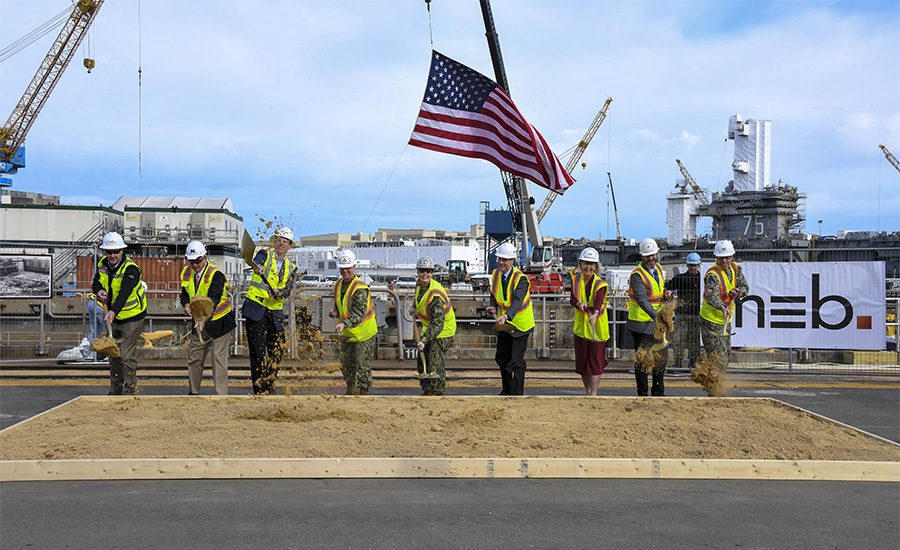

President Donald Trump on Dec. 18 signed the National Defense Authorization Act for Fiscal 2026, enacting almost $900 billion in protection coverage and formally embedding supply and contracting reforms that might reshape how army building is procured and executed.
The regulation authorizes protection coverage throughout the U.S. Dept. of Protection, together with acquisition reform and army building. Whereas remaining venture funding will depend on fiscal 2026 appropriations, the statute now offers protection building businesses express authority to make use of supply instruments that had beforehand been utilized inconsistently or cautiously.
RELATED
$900B Final Defense Bill Passes House With Sweeping Procurement, Infrastructure Changes
For engineering and building corporations, essentially the most consequential provisions are concentrated in Division B—Army Building Authorizations, significantly Title XXVIII, which governs how tasks could also be deliberate, contracted and delivered.
For the primary time, Congress has expressly approved progressive design-build for army building. Part 2809 permits the army departments to make use of “accelerated design-build and progressive design-build procedures” for MILCON tasks, eradicating long-standing uncertainty about whether or not collaborative, qualifications-based supply fashions are permissible beneath federal regulation.
Progressive design-build permits house owners to pick out groups primarily based on skills and collaborate throughout early design earlier than negotiating remaining value, moderately than locking in price on the proposal stage. State and native businesses have used the strategy on advanced tasks however beforehand lacked a transparent statutory footing throughout the Protection Dept.
The importance is sensible: the regulation now helps earlier contractor and designer involvement on tasks the place scope, website situations and sequencing dangers are troublesome to outline upfront, together with shipyard work, industrial services and abroad posture tasks.
RELATED
Navy Picks Eight Firms for $15B Pacific Deterrence Construction Contract
Multi-year Contracting Authority Extends Past Upkeep
The NDAA additionally expands DOD’s capacity to contract building work over a number of years. Part 2814 authorizes multiyear contracting authority for sure army building tasks, permitting businesses to construction supply past single-year execution home windows.
This authority is distinct from conventional annual MILCON contracting and is meant to enhance price management, workforce continuity and scheduling certainty on giant or phased packages. For contractors, it opens the door to longer planning horizons and probably fewer stop-start procurements on main installations.
In parallel, Part 2816 authorizes cost-plus-incentive-fee contracts for chosen tasks beneath the Navy’s Shipyard Infrastructure Optimization Program, acknowledging the technical complexity and threat profile of dry dock modernization and waterfront recapitalization work.
Past supply, the regulation reinforces long-term demand alerts. Part 2803 requires the army departments to develop and replace 20-year infrastructure enchancment plans, formalizing a multidecade planning framework for bases, depots and industrial services.
Different provisions develop eligible venture varieties and suppleness. Part 2807 explicitly consists of demolition tasks within the Protection Neighborhood Infrastructure Program, whereas Part 2804 strengthens necessities associated to water administration and safety on army installations—areas more likely to generate follow-on civil and environmental work.
Collectively, the enacted authorities level towards procurement shifts that ENR readers will wish to watch carefully. Businesses now have statutory backing to put higher emphasis on qualifications-based choice, early preconstruction providers and phased value improvement, significantly on advanced or high-risk tasks.
Companies with built-in design, price modeling, and constructability experience are seemingly higher positioned, as house owners achieve the pliability to defer remaining value commitments till design maturity improves. Multiyear authority additionally favors groups able to sustaining workforce and supply-chain capability throughout longer supply timelines.
Implementation will fall primarily to the U.S. Military Corps of Engineers, Naval Amenities Engineering Methods Command and Air Power Civil Engineer Heart, that are anticipated to concern inner acquisition steerage decoding the brand new authorities earlier than making use of them to approaching procurements.
Early adoption is predicted on technically advanced tasks—comparable to shipyard recapitalization, depot modernization and Indo-Pacific posture upgrades—however timing will depend upon company steerage and FY 2026 appropriations.
As with prior protection authorization payments, the regulation authorizes coverage moderately than appropriates funding. Nonetheless, by embedding supply reform straight into statute, the FY 2026 NDAA establishes a sturdy framework that might materially change how army building is deliberate, contracted and delivered over the following decade—properly past a single price range cycle.
Trending Merchandise

KAFAHOM Power Tool Organizer Wall Mount, 4-Tier Drill Holder for Cordless Tools, 2-Pack Set, Garage Storage Rack with Side Hooks for Hammers & Pliers, Tool Organizer for Workshop/Utility Room



XMJY 5 Pack Funny Hardhat Stickers – Can We Fix It? No, It’s Fucked, Cute Cartoon Hard Hat Stickers for Builder, Waterproof Vinyl Stickers for Tool Box, Helmet (3 inch)

Cisily Brown Sponge Holder for Kitchen Sink, Sink Caddy Organizer with High Brush Holder, Kitchen Countertop Organizers and Storage Essentials, Rustproof 304 Stainless Steel, Soap Dispenser Organize

Mohawk Fil-Stik Wax Putty Stick, White M230-0202, 1 Count


