
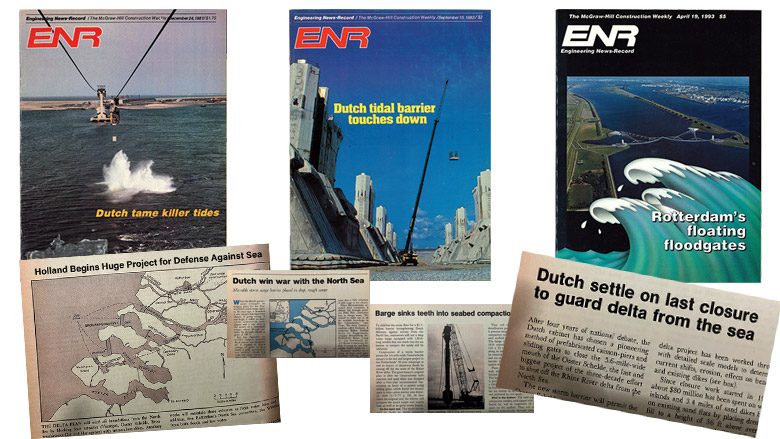

The world’s most refined and complicated flood barrier system immediately protects southwest Holland. It was developed in response to a disaster. A northwest storm mixed with a spring tide in 1953 propelled a tidal surge of rising depth down the tapering North Sea. The surge tore 500 breaches in dikes, flooded 600 sq miles of low-lying land within the Dutch Delta and took 1,835 lives. The Rijkswaterstaat, Holland’s water authority, with one of many world’s largest hydrologic engineering laboratories, crafted a complete grasp plan to stop a subsequent catastrophe.
The flood protection scheme options three giant dikes and a large, gated tidal barrier closing off 4 main estuaries within the Rhine-Meuse-Scheldt delta, in addition to further buildings totaling 15.5 miles in size. The development program took three many years to finish, and needed to be executed in an elaborate sequence. Along with safeguarding a 1,900-sq-mi estuarine space from storm tides, it aimed to unravel a rising salinity drawback.
By closing off a collection of broad, lengthy, interconnected inlets that penetrate the world, runoff from the Rhine and its distributaries was channeled in order that the estuaries had been transformed into three basins: contemporary tidal water within the north, salt water tidal within the Oosterschelde, and salt water non-tidal within the remaining two arms. 4 smaller basins, totaling 2,585 acres and holding 120,000-acre-ft, had been constructed as reserves of ingesting water, supplying 132 billion gallons yearly. The mission additionally shortened the shoreline by 430 miles, rendering 440 miles of dikes out of date, and offering a higher diploma of safety to the residents of the affected islands, in addition to stopping present farmland from being contaminated by salt water.
The Volkerak Works, consisting of a 2.8-mi-long dam, a 2.5-mi lock complicated and a 0.75-mile bridge, closed off an inland waterway that related two deep sea inlets. The core of the Volkerak Dam was made with floating concrete caissons, 149 ft lengthy x 49 ft extensive x 43.5 ft excessive, solid in a close-by dewatered constructing pit. The dam diminished tidal present velocities in 4 surrounding estuaries to permit subsequent building of the first dams. By modifying the unpredictable tidal currents, it additionally improved delivery. Begun in 1957, it was accomplished in 1969, with a further set of locks added by 1977. One of many busiest waterways in Europe, its locks had been dealing with 150,000 ships per yr in 1969.
The three-mi-long northernmost construction, Haringvliet Dam, includes a collection of 17 sluices and a delivery lock. The sluices let in salt water to stop freezing of the Meuse and Rhine Rivers, and likewise can drain the rivers in case of flooding. Work on the Haringvliet Dam started in 1956, with giant willow fascine mattresses positioned within the 75-ft-deep channel. A synthetic work island was constructed utilizing caissons the place the sluice gates had been constructed. Every gate has two sluices together with a seaward-facing one designed to interrupt the drive of the waves. Subsequent a cableway was erected, and it was used to ferry 93,000 enormous concrete blocks and dump them into the channel to type the core of the dam. Lastly the rest of the dam was constructed with sand and stone, and accomplished in 1970.
Subsequent got here the three.7-mi-long Brouwershavensche Dam between Schouwen and Goeree Islands, throughout a 100-ft-deep channel. It was additionally constructed utilizing mattresses. The dam’s sand core was positioned hydraulically and in tidal areas positioned between quarrystone quays. To guard the embankment toes from erosion, concrete sheet piles had been jetted into place and augmented with stones caged in gabions. On the seaward facet a 20-ft-wide layer of bituminous concrete stabilized the dam towards wave motion. The dam profile was designed with a low crest by including an 82-ft-wide, nearly horizontal outer berm to interrupt storm-driven waves. A cableway was used to dump 260,000 2.5-ton concrete cubes to shut off the southern part. The northern part was closed off with 14 concrete caissons, every measuring 223 x 59 x 53 ft and weighing 8,000 tons. Building lasted from 1962 to 1971.
The final and most troublesome of the Delta Works parts was the Oosterscheldekering, a 5.6-mile-long collection of dams and storm surge limitations throughout three channels as much as 130 ft deep. A preliminary stage concerned shallower parts of the estuary being sealed off by creating three work islands and a 2.3-mi, 120-ft-high sand dike.
Constructing Limitations
Initially conceived as a dam, environmentalists feared that closing the estuary would produce a brackish cesspool, killing its oyster and mussel beds and wildlife habitats and creating adversarial tidal motion at close by seashores. After 4 years of examine and debate it was determined that the centerpiece could be a 3.5-mi-long surge barrier. The limitations, break up between the three channels, characteristic a complete of 66 large concrete piers, every weighing 18,000 tons and spaced 148 ft aside, supporting 63 metal gates. Dosbouw, a consortium of 11 Dutch corporations, was the contractor.
Building of the limitations kicked off in 1976, with dredges carving a 265-ft-wide trench various from one to 105 ft deep. Then a specially-designed “deep densification pontoon” vessel, the Mytilus, moved into place—a 220 x 112 ft barge carrying 4 44-ton compaction needles suspended from a 150-ft scaffold, with a 100-ft-long horizontal metal truss lowered to the underside for help. The 138-ft-long metal pipe needles, every tipped with a finned bit, had been pushed into the sandy backside with 200-hp vibrators, compacting the sand 50 ft deep. The compaction work took 4 years.
Two mats had been positioned beneath every pier to guard the underside and preserve the piers stage. The primary mat, 15-in.-thick, incorporates three layers—sand, advantageous gravel and coarse gravel. The highest mat, additionally 15-in.-thick, incorporates three ranges of coarse gravel. The mats had been fabricated utilizing 12-ft-wide rolls of wire-reinforced material stitched collectively and fed into chain conveyors, combination positioned on them with wire baskets at intervals to stop shifting, and metal pins put in to seal the layers collectively. A particular barge, the Cardium, was constructed to position the 5,500-ton mats. Its 65-ft-dia reel suffered a collection of apparatus teething issues, resulting in months of delays, however succeeded in unrolling the 165-ft extensive, 660-ft-long mat sections into place. Extra nylon mats prolong nearly 2,000 ft on all sides of the barrier, held in place by blocks of concrete. Basis work wrapped up in 1984.
The monolithic piers had been prefabricated in a diked work pit within the estuary, and after each was accomplished the pit was flooded and an armada of vessels towed it into place over a 72-hour journey. Setting the piers into place required two particular vessels working in tandem. The Oostrea floated over a sunken monolith, picked it up utilizing grips hung from two gantry cranes and took it to the positioning. Then the Macoma, anchored in place at low tide, dredged away sand from the mat. Then the 2 vessels locked collectively and slowly lowered the pier into place inside very exact parameters. Layers of progressively bigger stones had been then piled round every construction, and the piers had been related with concrete field beams on the high and backside of the gate openings. Fabrication and set up of the piers took nearly 4 years. The world’s largest movable flood barrier was completed in 1986, and has been closed 28 occasions since then.
The whole Delta Works program, together with the elevating of dikes alongside rivers and estuaries, totaled $7 billion, of which the Oosterscheldekering accounted for $2.4 billion.
The Delta Works scheme all the time meant for the New Waterway, the ship canal forming the northernmost arm of the delta, to stay undammed, because it handles ship visitors to Rotterdam, the world’s largest port by tonnage from 1962 to 2004. So to guard Rotterdam from storm surges, Rijkswaterstaat conceived a large floating floodgate. Its two floating radial field girder buildings lodge inside dry docks within the canal banks when not in use, and represent one of many largest floating buildings on the planet.
Every hole metal gate is 690 ft extensive, 50 ft tall and 72 ft deep. Formed like curved ship hulls, every gate weighs 15,000 metric tons when empty. They’re held by 750-ft-long metal trusses, every having three tubular longitudinal chords as much as 6-ft-dia, related to ball-and-socket joints embedded in 100,000-ton concrete and sand anchorage. When harmful tides loom, the gates float out of their docks, closing off the 1,200-ft-wide channel. They’re then flooded and sink 55 ft, resting on concrete sills within the canal mattress. Building began in 1991 and was accomplished in 1997. The gates price $450 million. It has been closed twice, as soon as in 2007 and once more in 2023.
Trending Merchandise

KAFAHOM Power Tool Organizer Wall Mount, 4-Tier Drill Holder for Cordless Tools, 2-Pack Set, Garage Storage Rack with Side Hooks for Hammers & Pliers, Tool Organizer for Workshop/Utility Room



XMJY 5 Pack Funny Hardhat Stickers – Can We Fix It? No, It’s Fucked, Cute Cartoon Hard Hat Stickers for Builder, Waterproof Vinyl Stickers for Tool Box, Helmet (3 inch)

Cisily Brown Sponge Holder for Kitchen Sink, Sink Caddy Organizer with High Brush Holder, Kitchen Countertop Organizers and Storage Essentials, Rustproof 304 Stainless Steel, Soap Dispenser Organize

Mohawk Fil-Stik Wax Putty Stick, White M230-0202, 1 Count


