
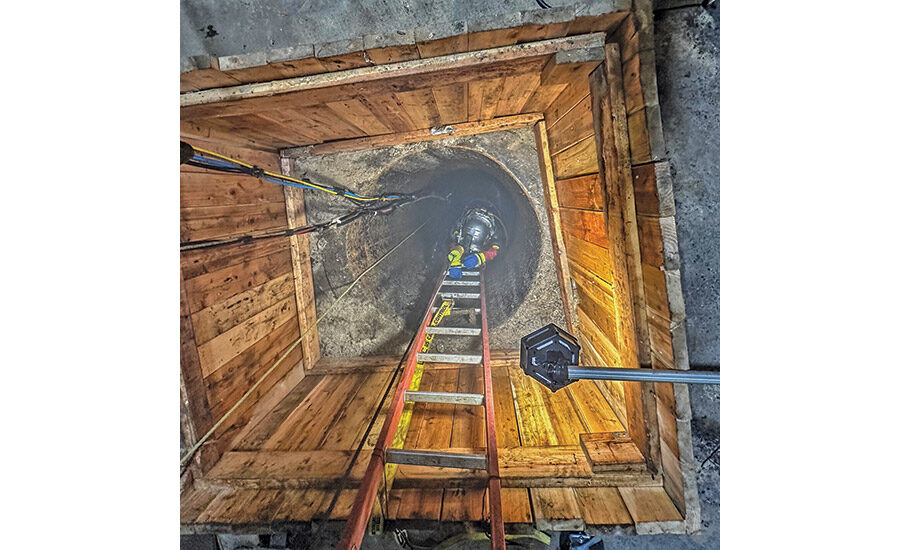
The deteriorating South Road interceptor sewer close to the South Road Seaport in Manhattan’s Monetary District had all of the makings of a multitude.
Situated practically 30 ft under the busy roadway, which itself underlies the FDR Drive viaduct, the 60-year-old concrete partitions of the practically 1,000-ft-long, 8-ft by 6-ft mixed sanitary and storm sewer have been more and more weak to infiltration from the adjoining East River, heightening the chance of overflow. Whereas rehabilitation was desperately wanted, New York Metropolis’s Dept. of Design and Development acknowledged that the complexities of such a big undertaking would solely amplify inherent disruptive results of a traditional open-trench restore strategy.

The infiltration was monitored and inspected for any leaks for 5 consecutive days earlier than employees proceeded to put in the spiral-wound liner previous this part into the interceptor sewer.
Photograph by YOR/JWP, courtesy the New York Dept. of Design and Development
“It might be noisy and harmful and require closing the road for months, if not years,” says Iyad Marzouq, the company director of infrastructure. “The design additionally must think about the FDR Drive foundations, any variety of adjoining utility strains and different elements.”
Marzouq provides that disabling the interceptor for an prolonged interval would require a brief bypass and pump system to supply round the clock in-series pumping of the 40 million gallon each day circulate, including not less than $12 million to the undertaking’s general value.
By the tip of 2024, nonetheless, few folks dwelling in or driving by the neighborhood seemingly realized that the practically $29-million interceptor rehabilitation undertaking was happening beneath their toes and was effectively on its strategy to completion, which is anticipated this 12 months.

Staff put in uniform liner materials within the interceptor sewer and efficiently lined previous the infiltration restore that was plated, finishing practically 350 ft of uniform lined sewer.
Photograph by YOR/JWP, courtesy the New York Dept. of Design and Development
The hot button is the town’s determination to make use of an modern trenchless development methodology known as spiral wound lining, wherein a steady strip of polyvinyl chloride (PVC) is mechanically wound by a pipeline to kind a uniform liner. A cementitious grout is then pumped into void house between the brand new rounded liner and current rectangular sewer construction.
Spiral wound lining was one in all a number of restore and relining options the division had rigorously evaluated for a number of years to handle the interceptor’s many issues. Not like different trenchless strategies that may have considerably lowered interceptor capability, the spiral wound lining course of can happen in moist circumstances utilizing submersible tools tailor-made to the pipeline’s configuration. This enables the interceptor to stay in service throughout development.
David Beesley, vice chairman and undertaking supervisor at contractor Coppola Providers, Ridgewood, N.J., says circulate velocity is the crucial issue. “So long as velocities are within the 1- to 2-feet per second vary, we are able to work safely in circulate ranges as much as about 18 to 24 inches,” he says.
To assist guarantee optimum working circumstances, Coppola scheduled work for the in a single day hours when circulate ranges usually are decrease, putting in a 30-linear-ft partial bypass line to quickly redirect 17.6 million gallons of each day interceptor circulate to a neighboring, smaller-diameter parallel sewer line whereas work was happening.
After every shift, the liner tools could be de-energized and the interceptor returned to full capability. “Some nights, the extent could be as little as 6 inches,” Beesley says.
As a result of the South Road interceptor could be not like any earlier spiral wound lining tasks, Coppola ready for the work through the use of a mock-up of the interceptor that was constructed within the firm’s tools yard.
“We had not accomplished a mock-up of that scale earlier than, however we wished to be prepared for what we might encounter on South Road,” Beesley says.

The workforce resolved the problem of constructing bulkheads throughout the slim circumstances by excavating or chipping the present host interceptor sewer pipe by about 1.5 in. throughout, which created room to put in bulkhead partitions with brick and mortar.
Photograph by YOR/JWP, courtesy the New York Dept. of Design and Development
Ironing Out Points
Even with the intensive preparation, the South Road interceptor undertaking posed no scarcity of surprises—together with a 10-month multi-agency allowing and coordinating course of that additionally required approval by the town’s Dept. of Environmental Safety, which operates the sewer system. Development lastly started in early 2024 with the partial bypass connection. By Might, Coppola was prepared to start lining work 5 nights every week, with a aim to common about 20 linear ft per shift.
“On some nights, we’d get the manufacturing we anticipated, however on others, only a fraction of it,” Beesley says, citing particles from the road’s normal-period flows as a continuing problem. “Issues construct up so quick, significantly because of the means the machine is positioned,” he explains. “Maintaining the tools clear proved extra time-consuming than we initially anticipated.”
Climate has been one other concern. Added stormwater from heavy rains often has value the workforce all or a part of a shift. Coppola additionally encountered unexpected modifications in interceptor dimensions as a result of aged irregular materials and sediment buildup that required employees to chip away concrete from the partitions and ceiling so lining equipment might go by.

The undertaking situated close to the South Road Seaport in decrease Manhattan entails the town’s first use of spiral-wound lining that permits the workforce to repair a significant sewer leak with out digging a trench.
Picture courtesy the New York Dept. of Design and Development
Whereas the Coppola workforce tailored to the circumstances and made gradual progress putting in the liner, the undertaking’s most vital difficulty awaited at in regards to the 300-ft level—a 3-in. by 8-in. wall cavity that every minute spewed as a lot as 100 gallons of water from the East River into the sewer.
Marzouq says the leak, which was the undertaking’s principal catalyst, repeatedly defied workforce makes an attempt for a everlasting repair. “It was like making use of a bandage,” he says. “As a result of there was a lot stress from the river, every little thing we tried appeared to fail inside just a few days.”
After 4 months of trial and error, the division says the cavity was lastly sealed utilizing a mix of hydrophobic materials and expandable moisture-activated resins. These have been then lined with fast-setting hydraulic cement and wire mesh. The ultimate step, bolting a 96-in. x 43-in. aluminum metallic plate to the interceptor wall, was accomplished effectively earlier than Coppola’s lining machine arrived.
“The leak didn’t delay that a part of the work in any respect,” Beesley says, including that the restore strategy will seemingly be used once more for an additional infiltration leak additional down the interceptor.

Putting in spiral-wound lining entails utilizing a water-resistant machine, constructed within the sewer, to create a brand new construction throughout the current one.
Picture courtesy the New York Dept. of Design and Development
Gaining Momentum
By the tip of 2024, Coppola was nearing the midway level of the liner set up and had begun grouting work. Plans name for the liner of the remaining part of interceptor to be full this summer season.
Up to now, the division is happy with how spiral wound lining has carried out. Marzouq sees different potential functions for extra metropolis underground infrastructure rehabilitation tasks the place an open-cut strategy could be problematic. “The undertaking is offering plenty of classes that ought to assist issues transfer extra shortly sooner or later,” he says.
“There’s no means you might do a undertaking like this with a traditional methodology,” Beesley provides, noting that the undertaking workforce encountered a bunch of utilities in merely digging down 20 in. to put in the bypass line.
“At the least we might cowl that reduce with plates and hold the road open,” he says. “Going 30 toes underground for the complete size of the undertaking would require huge excavation—and there’s no telling what you’d discover alongside the way in which.”
Trending Merchandise

KAFAHOM Power Tool Organizer Wall Mount, 4-Tier Drill Holder for Cordless Tools, 2-Pack Set, Garage Storage Rack with Side Hooks for Hammers & Pliers, Tool Organizer for Workshop/Utility Room



XMJY 5 Pack Funny Hardhat Stickers – Can We Fix It? No, It’s Fucked, Cute Cartoon Hard Hat Stickers for Builder, Waterproof Vinyl Stickers for Tool Box, Helmet (3 inch)

Cisily Brown Sponge Holder for Kitchen Sink, Sink Caddy Organizer with High Brush Holder, Kitchen Countertop Organizers and Storage Essentials, Rustproof 304 Stainless Steel, Soap Dispenser Organize

Mohawk Fil-Stik Wax Putty Stick, White M230-0202, 1 Count


