
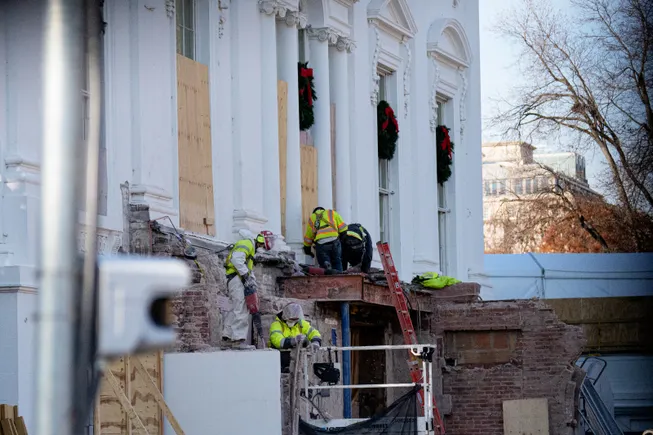
A federal choose on Tuesday cleared building on the White Home ballroom challenge to maneuver ahead, in keeping with a number of sources, however building attorneys say the ruling does little to cut back danger for the contractors tasked with constructing it.
The Nationwide Belief for Historic Preservation sued the Trump administration earlier this month to stop its ballroom construction project, which is now pegged at $400 million, double the preliminary estimate of $200 million, in keeping with The Hill. The lawsuit alleged the administration began demolition and early building exercise earlier than securing required approvals.
For contractors, that type of conditional inexperienced gentle creates a well-known however expensive drawback. Work can proceed, however so does uncertainty. The nationwide consideration the job has garnered spotlights the dangers contractors face when taking over a controversial challenge that will get mired in litigation.
“When litigation impacts a challenge like this, a contractor has two fast jobs,” stated Jason Lien, associate and co-chair of the development and actual property litigation group at Maslon, a Minneapolis-based legislation agency. “Work out what, if any, work can transfer ahead and the way a possible suspension of labor is addressed within the contract.”
The Trump administration introduced Bethesda, Maryland-based Clark Construction Group because the lead builder on the challenge in July, with Dallas-based AECOM offering engineering companies. Neither agency instantly responded to requests for remark for this story.
The White Home additionally tapped ACECO, a Silver Spring, Maryland-based contractor, for demolition of the East Wing. The agency couldn’t be reached for remark Wednesday.
Uncomfortable selections
The ballroom challenge differs sharply from a typical industrial or residential renovation, Chris Staine, associate at Shumaker, Loop & Kendrick, a Toledo, Ohio-based legislation agency, instructed Building Dive. One main issue is the administration’s choice to demolish the East Wing earlier than plans for the brand new ballroom have been accomplished or submitted for approval, he added.
Although house owners typically authorize demolition earlier than closing plans are full, Staine stated sequencing sometimes occurs solely after designs are considerably developed, and barely on a challenge of this scale and sensitivity.
“What’s so uncommon is that they proceeded, particularly since we’re speaking about not simply your customary backyard selection challenge,” Staine stated. “You’re speaking concerning the White Home. You’re speaking concerning the East Wing. They demolished it. That was fairly breathtaking to try this beneath the circumstances.”
From a contractor’s perspective, Staine stated some of the regarding points is being requested to carry out demolition work earlier than permits are permitted. That state of affairs would sometimes elevate crimson flags in nearly any jurisdiction.
“If I used to be a contractor and I used to be requested to maneuver ahead with demolition within the absence of a allow, clearly, I might be extraordinarily uncomfortable with that,” Staine stated. “I might place the proprietor on discover that such a directive runs counter to what the native constructing code and the constructing division’s necessities state.”
In that state of affairs, Staine stated a contractor would seemingly demand indemnification from the proprietor, and even nonetheless may decline to proceed.
“I don’t know that I might be comfy as a contractor,” he stated. “I might completely require that the proprietor indemnify me for the destructive penalties related to that sort of instruction.”
Favorable ruling doesn’t assure safety
As soon as litigation emerges, a contractor’s danger escalates rapidly, stated Lien. That’s true even when courts cease wanting ordering a right away shutdown.
“The dangers to the contractor rise rapidly as soon as a lawsuit enters the image,” Lien stated. “Litigation can gradual work, set off demobilization and remobilization, trigger inefficiencies, enhance materials prices or delay funds, none of which the contractor controls.”
That uncertainty turns into particularly necessary on extensively watched tasks such because the White Home ballroom, the place public scrutiny and authorized stress can spill past the courtroom and right into a building firm’s broader enterprise, he added.
“In higher-profile tasks just like the White Home ballroom challenge, contractors might discover themselves pulled into the dispute or the general public narrative even when that they had no position within the underlying controversy,” Lien stated. “Uncertainty burns cash by delays, fee slowdowns and undesirable consideration.”
In October, for instance, ACECO was the target of heightened on-line criticism, the corporate reported on the time.
Tuesday’s ruling from the federal choose underscored the chance. The choose stated the federal government needs to be ready to tear out below-ground work if it later prevents modifications to what occurs above floor, in keeping with the NBC report.
Contract particulars do the heavy lifting
Attorneys emphasize the development contract will develop into the contractor’s main safety in opposition to destructive outcomes.
“Contractors that navigate these conditions will deal with them like some other main challenge disruption,” Lien stated. “They doc price and schedule impacts, talk early and sometimes with the proprietor and hold their choices open in case the court docket orders a slowdown or shutdown.”
Staine echoed that view. He known as the development contracts “danger allocation autos” that in the end decide who absorbs delays and uncertainty when issues go improper.
“There are dangers which might be nicely past the contractor’s management,” stated Staine. “It’s these sorts of dangers {that a} contractor must be significantly aware of once they’re coming into into the contract, in order that they don’t seem to be being held chargeable for dangers which might be past their management.”
Whether or not a contractor chooses to remain on a challenge mired in litigation turns into a enterprise choice, formed by these contractual protections.
“Whether or not to remain comes all the way down to contract, money stream and fame. If these don’t line up, it might be time to stroll,” Lien stated. “A contractor’s fame takes successful when the general public stops seeing it as a builder and begins seeing it as a part of the battle.”
That call will in the end boil all the way down to a risk-reward calculation, stated Staine. The end result of that alternative will range as a result of agency measurement and general monetary resilience.
“Some contractors simply can’t climate sustained authorized battles,” stated Staine. “The juice simply isn’t well worth the squeeze.”
Trending Merchandise

KAFAHOM Power Tool Organizer Wall Mount, 4-Tier Drill Holder for Cordless Tools, 2-Pack Set, Garage Storage Rack with Side Hooks for Hammers & Pliers, Tool Organizer for Workshop/Utility Room



XMJY 5 Pack Funny Hardhat Stickers – Can We Fix It? No, It’s Fucked, Cute Cartoon Hard Hat Stickers for Builder, Waterproof Vinyl Stickers for Tool Box, Helmet (3 inch)

Cisily Brown Sponge Holder for Kitchen Sink, Sink Caddy Organizer with High Brush Holder, Kitchen Countertop Organizers and Storage Essentials, Rustproof 304 Stainless Steel, Soap Dispenser Organize

Mohawk Fil-Stik Wax Putty Stick, White M230-0202, 1 Count


